JAV3DLXF
The Wikipedia Enthusiast Communication Group ( Telegram : @wikipedia_zh_n , IRC : #wikipedia-en link , both connected) welcome everyone to join.
| [ Close ] |
The Battle of Moscow (1612) [ Edit ]
 | This entry needs to be edited to ensure proper use of grammar, words, tone , format , punctuation, etc. (February 16, 2015) |
| The Battle of Moscow in 1612 | |||||||
|---|---|---|---|---|---|---|---|
| Part of the Polish invasion of Russia | |||||||
 | |||||||
| Participating Party | |||||||
 Polish and Lithuanian Federation Polish and Lithuanian Federation |  Russian Tsarist State Russian Tsarist State | ||||||
| Commander and leader | |||||||
| Jan Carol Hodekevich | Pozharski Kuzma Minin | ||||||
| troops | |||||||
| Unknown | Unknown | ||||||
| Casualties and losses | |||||||
| Unknown | Unknown | ||||||
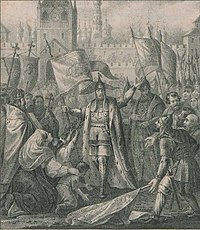
The 1612 Moscow Defence (Russian: Московская битва ) was a state of the Russian people’s uprising in the early 17th century that liberated Moscow from its Polish invasion. In the 17th century, Poland was a military power, and the country with the largest population and land area in Europe, with a population over 1100 million and territorial Han Gai today's Poland, Lithuania, Russia, Belarus, Latvia, Estonia, Moldova, Ukraine, Slovakia and other countries, 1612 years of Polish occupation of Moscow and the invasion of Russia , is a dark era of turbulent Russian history, the Tsar Ivan the Terrible After the emperor's death, there was no sudden death of the throne and the original Tsar Gordenov. At this time, the Polish king took the opportunity to attack Russia and continuously fostered two young sons Dmitry who called himself Tsar. On June 20, 1605, Dmitry led the Polish army. When he entered Moscow, he became a Tsar and he was known as "Pseudo-Dmitry I." In 1606, the Vasily Shujsky king launched a mutiny, killed Dmitry and crowned himself as a tsar. Pseudo-Dmitry I’s rule lasted 10 months after the collapse, but another person who claimed to be descended from Ivan IV ’s “Pseudo-Dmitry II” quickly launched an offensive with the assistance of the Polish army. This invasion was not defeated until 1609. Later, the Polish king Władysław IV simply declared himself to be the Russian tsar. In 1610, Poland attacked Russia in the second round. Wadiswaf, who was a teenager, was selected as the Russian tsar by Qi Boyar , but his father opposed it. The outbreak of people's uprisings in Russia, Władysław failed to truly ascend to the throne of Russia . However, he has been using Moscow until 1634The title of Grand Duke. 7,000 Polish elite cavalry defeated 40,000 Russians. At this time, Sweden in the north took the opportunity to attack and captured several cities in Russia, such as Novgorod, which plundered Russia. The Russian army was in chaos. Under the pressure of the representatives of the nobles in Moscow City, Tsar Shayce declared his abdication in July of that year and Moscow surrendered to open the city. At this time, Russia is in danger of completely losing its independence and sovereignty. On November 4, 1612, the civilian uprising forces Minin and Pozharsky launched a civil armed uprising to lift Polish rule.
table of Contents
[ hide ]- 1 Thefolk insurrectional force turns the tide
- 2The king of Poland calls himself the Russian tsar
- 3Russian National Solidarity Day
- 4related items
- 5References
Civil revolt against the tide [ edit ]

Russia's central regime almost disappeared and Russia almost died. At this time, the Russian people bravely stood up and shouldered the mission of saving the nation's destiny. The Moscow people launched an uprising in 1611. They robbed the armory and armed themselves and then rushed to the Kremlin. The Polish army stationed in the Kremlin launched a fierce battle with the rebels, but eventually the rebel army lost the Polish regular army. Afterwards, the wealthy businessman Kuzyma Minin of Nizhny Novgorod raised funds and the military general Dmitry Pozhars launched an uprising to organize a group of uprisings organized by a private fundraiser. The Polish regime in Moscow launched a near attack. The people in the villages and towns near Moscow on the way to the township have gradually joined the ranks of the uprising team and began to send troops. After arriving in Yaroslavl, Minin and Pozharsky again reorganized their troops. At this time, more and more insurgents joined the people along the way. After the expulsion of foreign enemies, Russia was able to recover and safeguarded the integrity of sovereignty. Free been divided up and split, and elected Luomannuofu's first dynasty in 1613 Tsar Mikhail I .
On April 6, 1617, the reconciled King Sigismund III of Poland took the last fight and ended up defeating Russia again. In 1618, Poland and Russia signed a peace treaty, after which the Polish national strength began to decline in the 18th century Russia , Austria , Prussia three partition of Poland .
Polish king calls himself Russian tsar [ edit ]
| Series entry | ||||||||||||||||||||||||||||||
| Russian history | ||||||||||||||||||||||||||||||
|---|---|---|---|---|---|---|---|---|---|---|---|---|---|---|---|---|---|---|---|---|---|---|---|---|---|---|---|---|---|---|
 | ||||||||||||||||||||||||||||||
As Poland intervened in the strengthening of Russian affairs , in 1609 the royal family moved to their palace in Vilnius , capital of the Grand Duchy of Lithuania . The Vilnius fire happened to happen at this time, even leaving the royal family away from their home in the Vilnius castle . Soon, only 15 years old 瓦迪斯瓦夫IV this year was Russian aristocracy " seven Boyar selected as the" czar , in Polish-Russian war and the Russian space during the period, the group had a tsar Vasily Shuysky is dismissed. However, Siegmund III , who wanted to convert the Russian people from the Orthodox Church to Catholicism , had prevented his son from reaching the Tsar's throne. Zygmunt refused to agree that Pyal had sent Prince Władysław to Moscow and sent him to the request of the Orthodox Church. Zigmont also proposed to allow him to rule as a Russian regent. This unrealistic proposal rekindled the hostility of the Russians. Soon afterwards, since 1610, Władysław carved his title "The All-Russian Tsar and the Grand Duke Vevradislav Zizimontovich" in mints from the mints of Moscow and Novgorod. Russian gold and silver coins ( Kopek ).
Władysław tried to regain the throne of the tsar with his own strength and launched an offensive in 1616. Despite some campaign victory, he failed to capture Moscow. The Confederation obtained some controversial territory in the Druno Peace Treaty , but Władysław failed to become a Tsar and later failed to obtain the Russian throne; the throne at this time was crowned by Tsar Mikhail Fyodor. Petrovich Romanoff obtains. However, until 1634, he always used the title of the Tsar.
Russian National Solidarity Day [ edit ]
In 1649, Tsar Alexei Mikhailovich issued a decree on November 4th as a national holiday. This day happened to be the date when Minin and Pozharsky led the ministry to liberate Moscow. Therefore, the two were commemorated on this festival. The national hero has also become a commemorative tradition for the Russian people and has lasted for more than 300 years.
In 1818, in memory of the achievements of Minin and Pozharsky’s liberation of Moscow, an unveiling ceremony for the two men’s monument was held in Moscow’s Red Square. This is the work of the Russian classicist sculptor Martos. The two heroes' hands are holding a sharp sword together, symbolizing the unity of the Russian people in the face of cruel foreign enemies.
After the October Revolution of 1917, the tradition of commemorating Minin and Pozharsky was cancelled by the Soviet government. On December 17, 2004, the Russian State Duma approved the "Russian Military Glory Day" on its third reading and decided to establish a new festival "People's Day of Unity." President Putin signed the decree in 2005 and every year on November 4th as a national holiday “Russian National Unity Day” to commemorate the Uprising of the Rebel Army in Minin and Pozharsky and expel the Polish invasion on November 4, 1612 The liberation of Moscow. [1] [2]
Related entries [ edit ]
- Partitioning Poland
References [ edit ]
- Бибиков Г. Н. Бои русского народного ополчения с польскими интервентами 22-24 августа 1612 г. под Москвой//Исторические записки. М., 1950. Т. 32. С. 173-197
- Andrzej Andrusiewicz, Dzieje Dymitriad 1602- 1614, t. I, II, Warszawa 1990
- Tomasz Bohun Moskwa 1612, Wydawnictwo Bellona 2005 ISBN 83-11-10644-4
- ^ http://big5.sputniknews.cn/tchinese.ruvr.ru/news/2014_11_04/279594664/Putin ofNational Solidarity Day presents flowers to Minin and Pozharsky Monument
- ^ http://news.xinhuanet.com/world/2014-11/06/c_1113149635.htmwhy Russia celebrates national unity day in high profile
9 categories :
- Moscow history
- Polish war
- Tsarist Russia war
- Ukrainian war
- 17th Century Poland
- 17th century Russia
- Cossack
- 1610 Europe
- 1612


Comments
Post a Comment